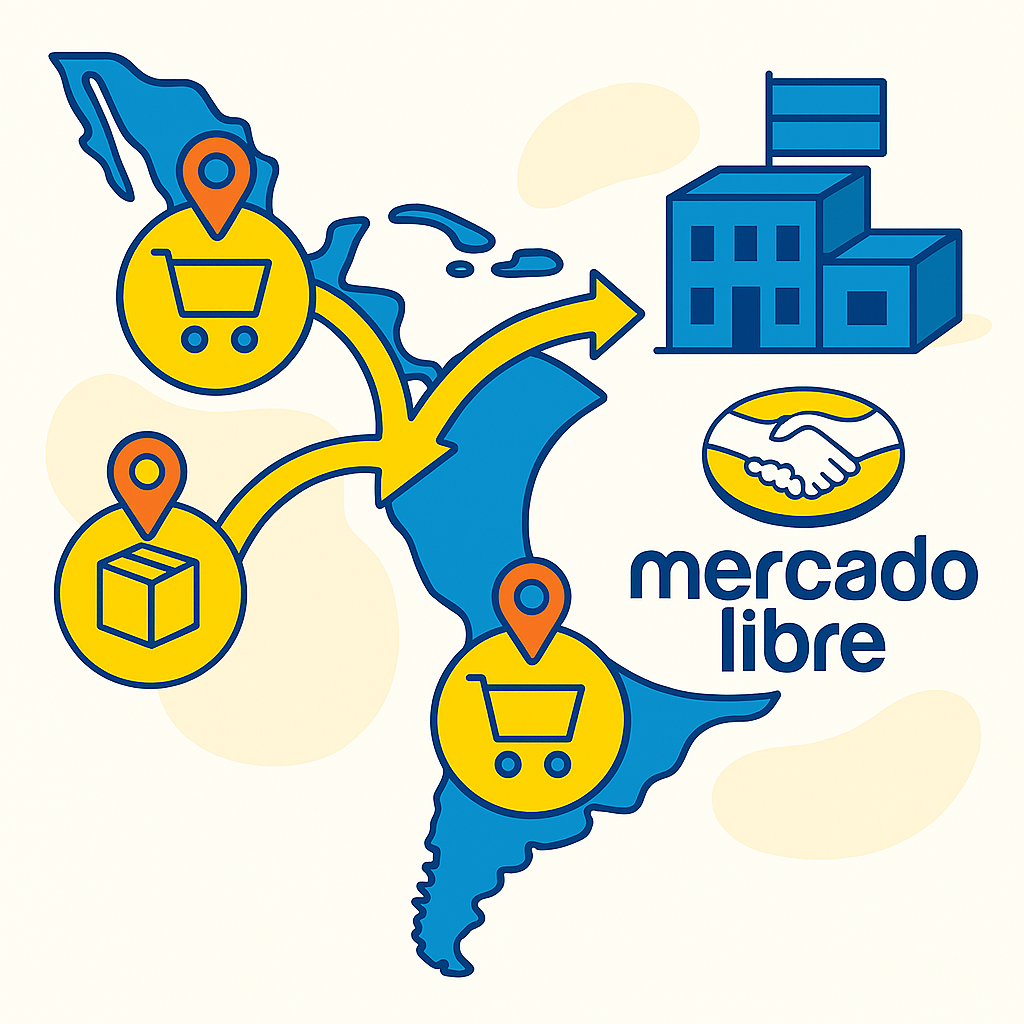

When Marcos Galperin pitched the idea for Mercado Libre at Stanford in 1999, e-commerce in Latin America faced a problem more fundamental than consumer behavior or internet access: the basic infrastructure for online commerce did not exist.
There were no reliable payment rails for online transactions. There was no trusted system for verifying buyers or sellers. There was no logistics network capable of delivering packages consistently across the fragmented geographies of Argentina, Brazil, Mexico, and Colombia.
Galperin’s response was not to wait for the infrastructure to arrive. It was to build it himself.
The Infrastructure Company Disguised as a Marketplace
Mercado Libre’s visible product was always its marketplace — a place where individuals and businesses could buy and sell goods across Latin American countries. But its actual competitive moat was built underneath that marketplace, layer by layer, over two decades.
MercadoPago, launched in 2003, created a digital payment system that allowed transactions between parties who had no shared banking relationship — critical in a region where bank account penetration was low and cross-border payments were structurally complex. MercadoEnvios, its logistics arm, built a delivery network that reached regions where no courier company offered consistent service.

“We are not a marketplace. We are the infrastructure of commerce in Latin America.” — Marcos Galperin
When Amazon entered Latin America, it encountered something unusual: a competitor that had already built the payment system, the logistics network, the buyer-seller trust framework, and the merchant relationships that it would have needed years to construct. Amazon’s advantages — brand, capital, technology — could not shortcut the decade of relationship-building that Mercado Libre had done inside each market.
The Trust Layer That Money Could Not Buy
Perhaps Mercado Libre’s most underappreciated asset was its reputation system. In a region where consumer fraud was common and institutional trust in online transactions was fragile, Mercado Libre invested heavily in seller verification, buyer protection, and dispute resolution processes that gave users a reason to transact with strangers.
This was not glamorous work. It was legal, operational, and customer service infrastructure — the unsexy foundation that made everything else possible. But in markets where that trust did not exist by default, building it became a durable barrier that no amount of marketing spending could replicate quickly.
By 2023, Mercado Libre had a market capitalization exceeding $70 billion and processed more than $40 billion in payment volume annually. It had become the most valuable company in Latin America by building the plumbing of a regional economy, not just a website on top of it.
The Key Lesson From Mercado Libre
In markets where the foundational infrastructure for your industry does not exist, the company willing to build that infrastructure — not just the product that sits on top of it — earns a structural advantage that is extraordinarily difficult to replicate. Mercado Libre did not compete with Amazon on user experience. It competed by being embedded in the operational reality of Latin American commerce in ways that no external entrant could match without decades of parallel effort.
Core Lesson: In emerging markets, the greatest competitive moat is often not your product — it is the infrastructure you build to make your product possible. If that infrastructure didn’t exist before you built it, every competitor who follows you will be forced to either build their own or rely on yours.